
Market Commentary - April 2026
We hope that everyone is enjoying the first days of spring. It looks like the snowy days are behind us here in Maine! Our original plan for the second quarter commentary was to switch things up a bit – and focus on the prevalence of financial fraud and scams, including steps on how to protect yourself.
In light of the geopolitical situation roiling markets, we decided to postpone the discussion on financial fraud and scams, and, instead, provide our thoughts on current events. As you are aware, beginning on February 28th, the U.S. and Israel initiated a joint military campaign against the Iranian regime. This military action has evolved and escalated, causing market turbulence and threatening to slow the global economy.
There is great uncertainty about the length and consequences of this unfolding conflict. The initial attack escalated into a regional war that impacts critical supply chains – Iran has effectively closed the Strait of Hormuz, causing a global energy shock. Roughly 20% of the world’s oil is shipped through this Strait. Since the start of the war, the price of oil has risen sharply.
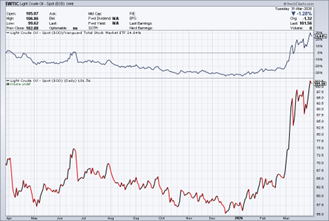
Figure 1 – Crude Oil WTI
Source: stockcharts.com
Sustained higher energy costs will cause the global economy to slow and lead to higher inflation. According to the International Monetary Fund (IMF), every 10% increase in oil prices (assuming they persist for most of the year) will push up global inflation by 0.4 percentage points and reduce economic output by as much as 0.2 percentage points.
Many economists remain cautiously hopeful that the global economy can withstand this crisis, particularly if there is a de-escalation or resolution in the near term. The room for optimism is based on the economy’s resilience in the face of recent events, including the newly imposed tariffs around the globe and the rising price of oil following the Russian invasion of Ukraine.
Investors have followed the geopolitical events with unease. Since the beginning of the conflict, the broad U.S. stock market is down approximately 5.50%. Developed international stocks and emerging market companies have fared even worse, as investors assess the impact of higher energy prices across the globe. The U.S. is viewed as less susceptible to energy shocks compared to many countries in Europe and Asia based in part on record high domestic crude oil production. The U.S. is now a net exporter of total petroleum.
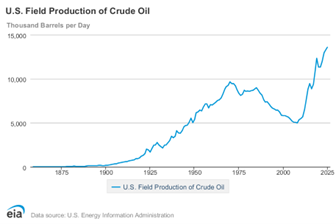
Figure 2 – U.S. Field Production of Crude Oil
Source: U.S. Energy Information Administration
Echoing the uncertain outcomes faced by the economy, the Federal Reserve left interest rates unchanged in March. When asked about the impact of the current situation, Federal Reserve Chair Powell told reporters “(t)he economic effects could be bigger. They could be smaller. They could be much smaller or much bigger. We just don't know.” This captures the level of uncertainty prevailing among economists and investors.
We continue to monitor these geopolitical events as they unfold. We understand that this conflict and the associated market volatility can be unsettling. Please don’t hesitate to reach out to us to schedule a time to connect.
We will revisit the topic of financial fraud and scams in future commentary. As a product of our firm structure, we have personal and comprehensive interactions with our clients. This, along with our established processes and procedures, allows us to help our clients avoid attempts at fraud and deception. We aim to be a resource for you in this area and encourage you to reach out to us with any specific questions.
- Jason, Micah, Tim, & Victoria